The Real Cost of Debugging CI/CD Failures in Modern Teams
Why CI/CD Failures Are More Expensive Than They Seem
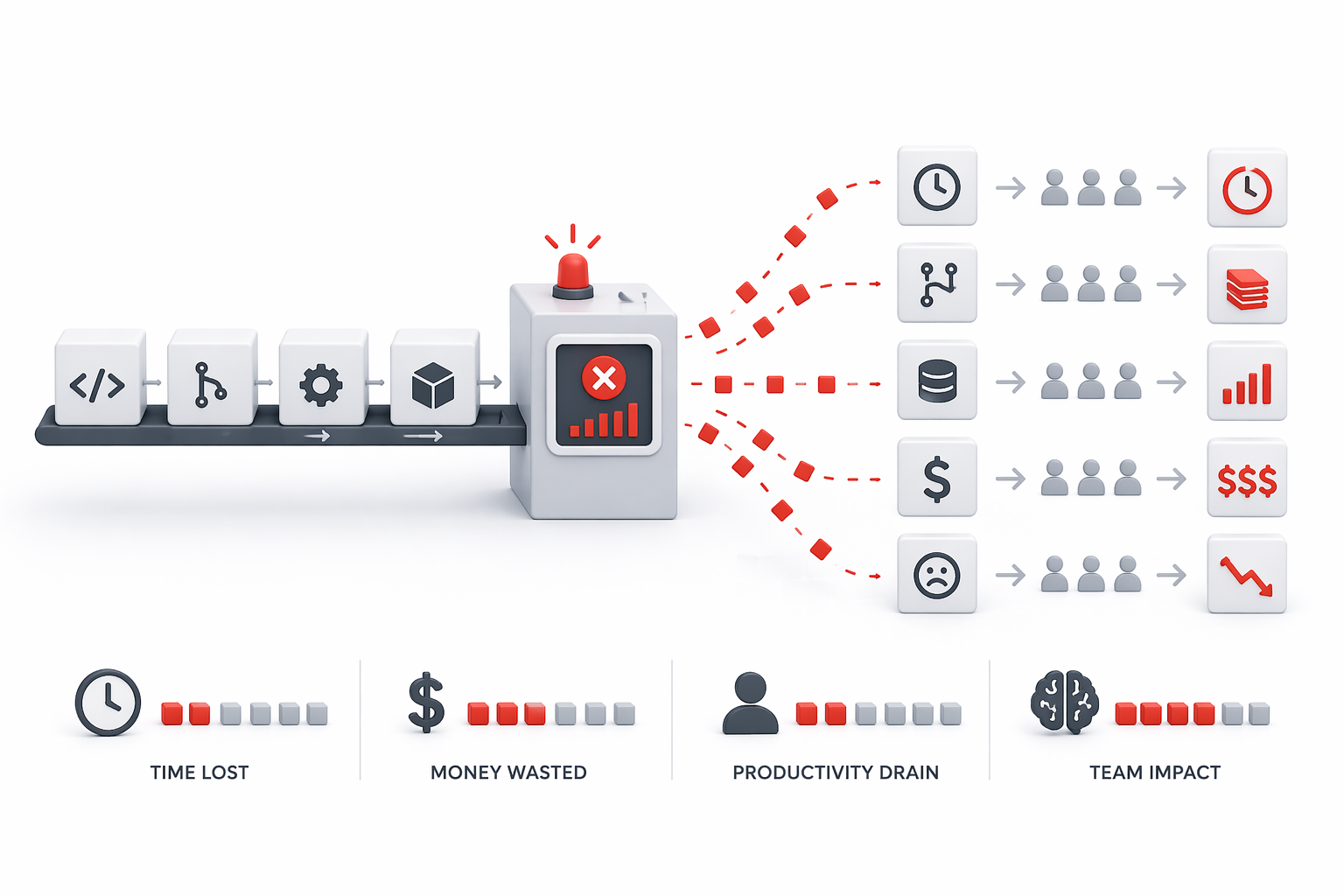
At first glance, a failed CI/CD pipeline doesn’t look like a big deal. A red build, a quick fix, maybe a rerun—and you move on. But that surface-level view hides a deeper reality. CI/CD failures are rarely isolated incidents. They ripple through teams, delay work, and quietly drain both time and energy.
Modern development teams rely heavily on automation. CI/CD pipelines are supposed to be the safety net that ensures code quality and fast delivery. When that safety net fails, everything slows down. Developers stop what they’re doing, investigate logs, rerun builds, and try to figure out what went wrong. That interruption alone has a cost, but it doesn’t stop there.
What makes CI/CD failures particularly expensive is their unpredictability. Unlike a clear bug in code, pipeline failures often involve environment issues, flaky tests, or infrastructure quirks. These aren’t always easy to diagnose. A failure might disappear on rerun, only to come back later. That inconsistency creates uncertainty, and uncertainty is expensive.
There’s also a compounding effect. One failure might block multiple developers, delay merges, and push back releases. Over time, these small disruptions accumulate into significant productivity loss. Teams often underestimate this because the cost isn’t tracked directly—it’s spread across time, attention, and missed opportunities.
Understanding the real cost means looking beyond the failed build itself. It means recognizing how deeply CI/CD is embedded in the development workflow—and how disruptive it becomes when that system breaks down.
The Illusion of “Just a Broken Build”
It’s easy to dismiss a CI failure as “just a broken build.” After all, builds fail all the time, right? But this mindset is misleading. A failed build is not just a technical issue—it’s a workflow interruption.
When a build fails, developers are forced to switch context. They might be in the middle of implementing a feature or reviewing code, and suddenly they need to dive into debugging logs. This shift isn’t free. Studies in cognitive science suggest that regaining focus after an interruption can take anywhere from 10 to 25 minutes. Multiply that by multiple failures per day, and the cost becomes significant.
There’s also the issue of ownership. Sometimes it’s unclear who is responsible for fixing the failure. Is it the person who wrote the code? The one who last touched the pipeline? Or someone from DevOps? This ambiguity can lead to delays and duplicated effort.
Another hidden cost is the tendency to rerun builds without understanding the root cause. If a failure disappears on rerun, teams might ignore it. But this creates a false sense of stability. The underlying issue remains, waiting to resurface at a worse time.
Treating CI failures as minor inconveniences prevents teams from addressing systemic problems. Over time, this leads to fragile pipelines and increasing technical debt.
How Small Failures Cascade Into Bigger Problems
A single CI failure might seem harmless, but in a collaborative environment, it rarely stays isolated. Modern teams work on shared repositories, where multiple developers depend on the same pipeline. When one build fails, it can block others from merging their changes.
This creates a domino effect. Developers start piling up changes, waiting for the pipeline to stabilize. Merge conflicts increase, integration becomes harder, and the risk of introducing new bugs grows. What started as a small issue quickly escalates into a broader problem affecting the entire team.
There’s also the impact on release cycles. If failures occur frequently, teams may delay deployments to avoid risk. This slows down delivery and reduces the ability to respond quickly to user needs. In competitive environments, even small delays can have significant consequences.
Another cascading effect is on testing reliability. Frequent failures—especially flaky ones—erode confidence in the pipeline. Developers may start ignoring failures or bypassing checks, which defeats the purpose of CI/CD altogether.
The key insight is that CI failures are not isolated events. They are interconnected disruptions that can amplify over time, affecting productivity, quality, and team morale.
Developer Productivity Drain
When CI/CD pipelines fail, the most immediate and measurable impact is on developer productivity. But this isn’t just about losing a few minutes here and there. The real cost lies in how these failures disrupt focus, fragment workflows, and force developers into reactive modes instead of productive ones.
Modern development thrives on momentum. When a developer is “in the zone,” they’re solving problems, writing clean code, and making meaningful progress. CI failures break that momentum instantly. Instead of moving forward, developers are pulled backward—into logs, error messages, and guesswork. This shift is not just inconvenient; it’s mentally taxing.
The cost becomes even more visible in teams practicing continuous integration with frequent commits. A single developer might interact with the pipeline dozens of times a day. If even a small percentage of those interactions result in failures, the cumulative time loss becomes significant.
There’s also a hidden opportunity cost. Time spent debugging CI issues is time not spent building features, improving architecture, or fixing real bugs. Over weeks and months, this diversion can slow down innovation and reduce the overall output of the team.
What makes this worse is that CI debugging often lacks clear feedback loops. Unlike coding, where progress is visible, debugging pipelines can feel like trial and error. This unpredictability adds to the frustration and extends the time needed to resolve issues.
Context Switching and Cognitive Load
One of the most underestimated costs of CI/CD failures is context switching. Developers are often deep in thought when writing code, holding multiple layers of logic in their heads. When a pipeline fails, they’re forced to drop that mental model and switch to a completely different task—debugging infrastructure or test issues.
This switch isn’t instant. The brain needs time to unload one context and load another. Research suggests that frequent context switching can reduce productivity by up to 40%. In practical terms, this means that a five-minute interruption can easily turn into a 20-minute productivity loss.
Cognitive load also increases because CI failures often involve unfamiliar territory. A backend developer might suddenly need to understand deployment scripts, container logs, or network issues. This mismatch between expertise and task complexity slows down problem-solving.
Another layer of complexity comes from incomplete information. CI logs can be noisy, fragmented, or hard to interpret. Developers must piece together clues, often without clear guidance. This mental effort adds up, leading to fatigue over time.
The result is not just slower work, but lower-quality work. Frequent interruptions make it harder to maintain focus, increasing the likelihood of mistakes and reducing overall efficiency.
Time Lost in Reproducing Issues
Reproducing CI failures locally is often one of the most time-consuming parts of debugging. The irony is that many CI issues don’t appear locally at all—that’s why they’re so frustrating in the first place.
Developers might spend hours trying to mimic the CI environment: matching dependency versions, setting environment variables, or running tests in specific conditions. Even then, the issue might not reproduce, leaving them stuck in a loop of guesswork.
This process is inherently inefficient. Instead of directly fixing the problem, developers are first trying to recreate it. It’s like trying to solve a puzzle without knowing what the final picture looks like.
The lack of reproducibility also leads to over-reliance on CI reruns. Developers push small changes, wait for the pipeline to run, and see if the issue is resolved. Each cycle can take several minutes—or longer—turning debugging into a slow, iterative process.
Over time, this creates a feedback bottleneck. The slower the feedback, the longer it takes to resolve issues. And the longer it takes, the more it disrupts the development flow.
Impact on Team Velocity and Delivery
CI/CD pipelines are designed to accelerate delivery. When they fail, they do the exact opposite. The impact on team velocity can be significant, especially in fast-paced environments where frequent releases are the norm.
Velocity isn’t just about how fast code is written—it’s about how quickly it moves from development to production. CI/CD is the bridge that enables this flow. When that bridge is unstable, everything slows down.
One of the most visible effects is delayed merges. If the pipeline is failing, developers can’t confidently merge their changes. This creates a backlog of pending work, increasing the complexity of future integrations.
Another issue is coordination overhead. Teams may need to communicate more frequently to resolve pipeline issues, coordinate fixes, or decide when it’s safe to merge. This adds friction to the workflow and reduces efficiency.
Over time, these delays accumulate. What should be a smooth, continuous process turns into a stop-and-go system, where progress is constantly interrupted.
Delayed Releases and Missed Deadlines
In many organizations, CI/CD pipelines are directly tied to release processes. A failing pipeline can delay deployments, even if the underlying code is ready. This creates a disconnect between development progress and delivery.
Deadlines become harder to meet because the timeline now includes not just development time, but also unpredictable debugging time. A feature that should take a day might take two or three, simply because of pipeline issues.
This unpredictability makes planning difficult. Teams can’t accurately estimate how long tasks will take, leading to missed commitments and frustration among stakeholders.
There’s also a business impact. Delayed releases mean delayed value delivery. Whether it’s a new feature, a bug fix, or a performance improvement, users have to wait longer. In competitive markets, this delay can have real consequences.
Bottlenecks in Shared Pipelines
Most teams use shared CI/CD pipelines, where multiple developers rely on the same system. When that system fails, it becomes a bottleneck.
For example, if the main branch pipeline is broken, no one can merge changes safely. Developers may either wait or try to work around the issue, both of which slow down progress.
Queue times can also increase. If pipelines take longer due to failures or retries, developers spend more time waiting for feedback. This waiting time adds up, especially in large teams.
Shared bottlenecks amplify the impact of individual failures. What might be a minor issue for one developer becomes a team-wide slowdown.
Financial Costs of CI/CD Failures
While the technical and productivity impacts are obvious, the financial costs of CI/CD failures are often overlooked. These costs are not always visible in budgets, but they are very real.
Every minute spent debugging is a minute of paid engineering time. Multiply that across a team, and the numbers add up quickly. Even small inefficiencies can translate into significant expenses over time.
There’s also the cost of infrastructure. CI/CD pipelines consume compute resources, storage, and network bandwidth. Failed builds and repeated runs increase this consumption, leading to higher operational costs.
In cloud-based environments, these costs are directly tied to usage. More failures mean more compute time, which means higher bills.
Infrastructure and Compute Waste
CI/CD systems rely heavily on cloud infrastructure. Each pipeline run consumes CPU, memory, and storage. When builds fail and need to be rerun, this consumption increases.
For example, a pipeline that takes 10 minutes to run might need to be executed multiple times to resolve a failure. This multiplies resource usage without adding value.
Caching and optimization can help, but they don’t eliminate the problem. As teams scale, the cost of wasted compute becomes more noticeable.
Hidden Labor Costs
The biggest financial cost is often labor. Developers are highly skilled professionals, and their time is valuable. When they spend hours debugging CI issues, that time is effectively lost from a business perspective.
This cost is compounded by inefficiency. Debugging CI issues is often slower and less predictable than regular development work. It requires more effort for less output.
Over time, these hidden costs can significantly impact the overall efficiency and profitability of a team.
Psychological and Cultural Impact
CI/CD failures don’t just affect systems—they affect people. Over time, repeated pipeline issues begin to shape team culture in subtle but meaningful ways. What starts as occasional frustration can evolve into a persistent sense of friction that impacts motivation, collaboration, and even how developers perceive their work.
One of the most immediate effects is emotional fatigue. Debugging CI failures often feels like solving problems that “shouldn’t exist.” Unlike building features or fixing known bugs, pipeline issues can feel arbitrary and disconnected from the actual product. This disconnect makes the work less satisfying and more draining.
There’s also a sense of unpredictability. Developers may hesitate before pushing code, wondering whether the pipeline will pass or fail. This hesitation slows down workflows and creates unnecessary stress. Over time, it can lead to risk-averse behavior, where developers avoid making changes that might trigger failures—even if those changes are beneficial.
Another cultural shift happens when CI failures become normalized. Teams might start accepting broken pipelines as “just part of the process.” This mindset lowers standards and reduces the urgency to fix underlying issues, allowing technical debt to accumulate.
Healthy engineering cultures rely on trust—trust in tools, processes, and teammates. When CI/CD systems are unreliable, that trust begins to erode.
Frustration and Burnout
Repeated CI failures can be surprisingly draining. Each failure requires attention, investigation, and resolution. When this happens frequently, it creates a cycle of interruption and frustration.
Developers may feel like they’re spending more time fighting the system than building meaningful features. This imbalance can lead to disengagement, where work becomes more about resolving issues than creating value.
Burnout doesn’t happen overnight. It builds gradually through repeated friction. CI failures contribute to this by adding constant, low-level stress. Even small issues, when repeated often enough, can have a significant cumulative effect.
Another factor is lack of control. Many CI issues involve infrastructure, networking, or external dependencies—areas that developers may not fully understand or control. This lack of ownership can make problem-solving feel more difficult and less rewarding.
Loss of Trust in CI Systems
Trust is critical for CI/CD to function effectively. Developers need to believe that a passing build means their code is safe, and a failing build indicates a real problem. When pipelines become unreliable, this trust breaks down.
Flaky tests are a major contributor. If tests fail randomly, developers start to question their validity. They may rerun pipelines without investigating failures, assuming they’re false positives. This behavior undermines the purpose of CI/CD.
Similarly, frequent infrastructure-related failures can make developers skeptical of the entire system. Instead of relying on CI as a source of truth, they may rely more on local testing or manual checks.
This shift has serious consequences. It reduces confidence in releases, increases the risk of bugs reaching production, and weakens the overall development process.
Debugging Complexity in Modern Architectures
Modern software architectures have made CI/CD pipelines more powerful—but also more complex. Monolithic systems have given way to microservices, distributed systems, and cloud-native applications. While these approaches offer scalability and flexibility, they also introduce new challenges when things go wrong.
In a simple system, a failure might be easy to trace. In a distributed architecture, a single failure can involve multiple services, environments, and dependencies. Debugging becomes a multi-layered problem that requires understanding how different components interact.
CI/CD pipelines must orchestrate builds, tests, and deployments across these components. This orchestration adds complexity, increasing the number of potential failure points.
The more moving parts you have, the harder it is to identify the root cause of a failure. Logs may be scattered across systems, and errors may propagate in unexpected ways.
Microservices and Distributed Systems
Microservices architectures break applications into smaller, independent services. While this improves scalability, it also complicates CI/CD pipelines. Each service may have its own build process, dependencies, and deployment pipeline.
When a CI failure occurs, it’s not always clear which service is responsible. The issue might originate in one service but manifest in another. This makes debugging more time-consuming and requires a broader understanding of the system.
Integration testing becomes more challenging as well. Testing interactions between services often involves complex setups, including multiple environments and network configurations. These setups are more prone to failure than simple unit tests.
Flaky Tests and Non-Determinism
Flaky tests are one of the biggest challenges in CI/CD. These are tests that sometimes pass and sometimes fail without any changes to the code. They introduce uncertainty and make it difficult to trust pipeline results.
Flakiness often stems from non-deterministic behavior—timing issues, shared state, or reliance on external systems. In CI environments, where conditions vary, these issues become more pronounced.
The cost of flaky tests goes beyond debugging time. They reduce confidence in the entire testing process, leading to ignored failures and weaker quality control.
Observability and Debugging Challenges
One of the core difficulties in debugging CI/CD failures is lack of visibility. When something breaks locally, developers can inspect the environment, add logs, and experiment freely. In CI, they’re often limited to logs and predefined outputs.
This lack of observability makes it harder to understand what went wrong. Logs may be incomplete, poorly formatted, or missing critical information. Without clear insights, debugging becomes a guessing game.
Another challenge is the ephemeral nature of CI environments. Each run may use a fresh environment that disappears after execution. This makes it difficult to inspect the system after a failure.
Poor Logging and Lack of Visibility
Logs are the primary tool for debugging CI issues, but they’re often insufficient. Many pipelines produce large volumes of logs without clear structure, making it hard to find relevant information.
Important details may be buried or missing entirely. Without proper logging practices, developers spend more time searching for clues than solving problems.
Difficulty Reproducing CI Environments
Reproducing CI issues locally remains one of the biggest challenges. Differences in environment, configuration, and infrastructure make it hard to replicate failures.
Without reproducibility, debugging becomes trial and error. Developers rely on repeated pipeline runs, which slows down the process and increases frustration.
Strategies to Reduce Debugging Costs
Reducing the cost of CI/CD failures requires a proactive approach. Instead of reacting to issues, teams need to design systems that minimize the likelihood and impact of failures.
This involves improving visibility, standardizing environments, and adopting practices that promote consistency and reliability.
Shift-Left Testing and Early Detection
Shift-left testing focuses on catching issues earlier in the development process. By running tests locally and during early stages of the pipeline, teams can identify problems before they reach CI.
This reduces the number of failures and shortens debugging cycles. Early feedback is faster and easier to act on.
Standardizing Environments and Tooling
Consistency is key to reducing CI issues. Using the same environments, tools, and configurations across local and CI systems eliminates many sources of failure.
Containerization, version management, and infrastructure-as-code all contribute to this consistency. When environments are predictable, debugging becomes simpler and faster.
Conclusion
The real cost of debugging CI/CD failures goes far beyond broken builds. It affects productivity, team velocity, financial resources, and even team morale. What seems like a minor technical issue can ripple through an entire organization, creating delays and frustration.
By understanding these hidden costs, teams can take steps to reduce them. Reliable CI/CD pipelines are not just a technical goal—they’re a critical part of efficient, sustainable software development.

ASD Team
The team behind ASD - Accelerated Software Development. We're passionate developers and DevOps enthusiasts building tools that help teams ship faster. Specialized in secure tunneling, infrastructure automation, and modern development workflows.