The Evolution of Developer Infrastructure: From Local to Distributed
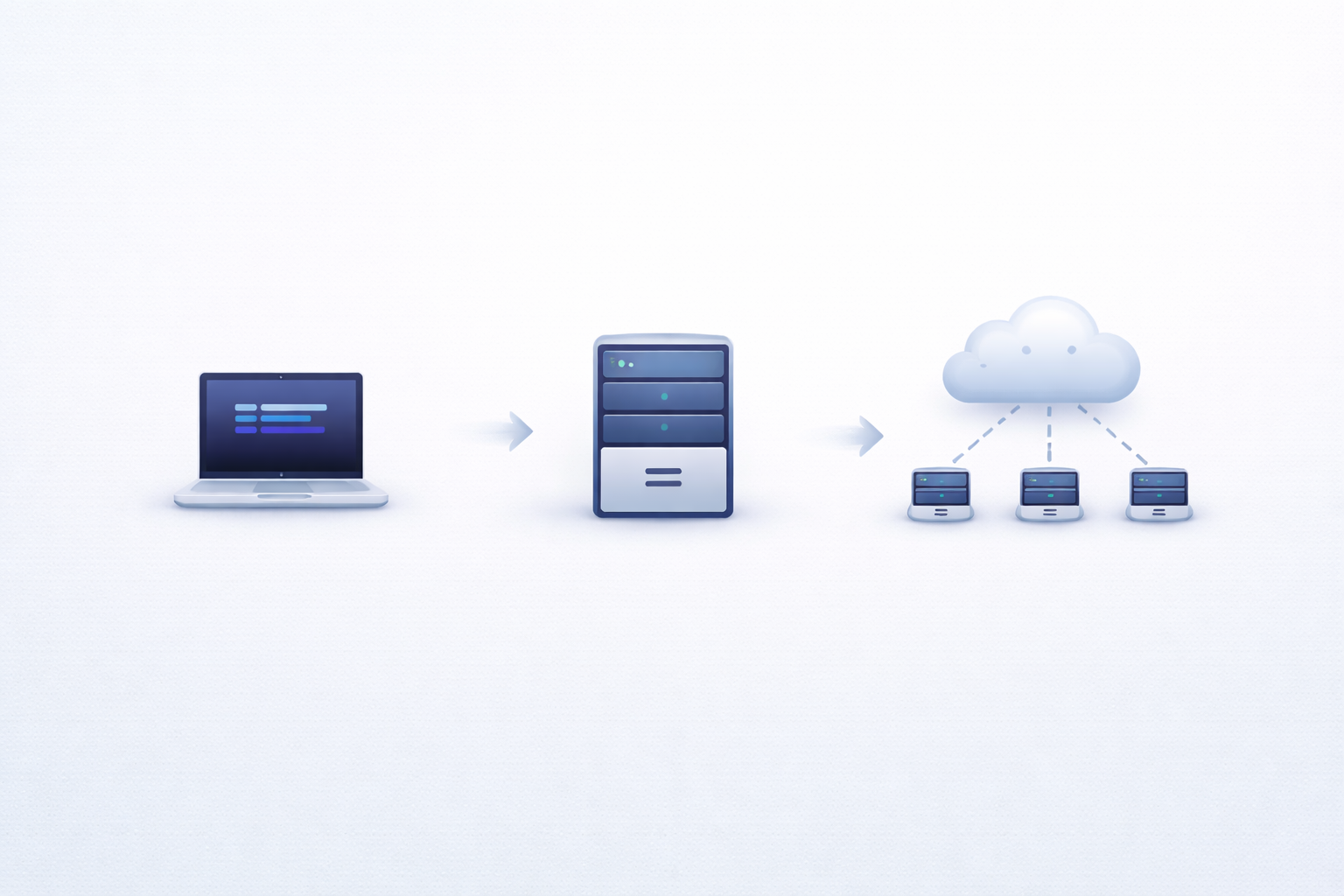
The Early Days of Local Development
Everything Ran on One Machine
There was a time—not that long ago—when software development was almost entirely local. You had your code, your database, your runtime, and everything else running on a single machine. No cloud, no containers, no orchestration layers. Just you and your setup.
It sounds simple, and honestly, it was.
Developers would install the necessary tools directly on their machines, configure everything manually, and start building. If something broke, you knew exactly where to look—because everything lived in one place.
This setup had a certain clarity to it. There were fewer moving parts, fewer unknowns, and fewer external dependencies. Debugging was straightforward because the system was self-contained.
But simplicity came with limits.
As applications grew, so did their requirements. Running everything on one machine became less practical. Performance constraints, scalability issues, and the need for collaboration started to push development beyond the boundaries of local environments.
Still, there’s something important to understand here: local development shaped how we think about software.
Many of the assumptions developers still hold—like being able to reproduce issues easily or having full control over the environment—come from this era.
And as we’ll see, those assumptions don’t always hold up anymore.
Simplicity and Control
What made local development so appealing wasn’t just simplicity—it was control.
Developers had full ownership over their environment. They could install, modify, and configure anything they needed. There were no external constraints, no shared infrastructure, no complex deployment pipelines.
If something didn’t work, you could tweak it immediately.
This level of control made experimentation easy. Developers could try new ideas, test changes quickly, and iterate without friction.
But control also meant responsibility.
Each developer had to maintain their own environment. And as projects grew, keeping those environments consistent became harder.
Two developers working on the same project might have slightly different setups. At first, those differences didn’t matter much. But over time, they started to cause issues.
That’s where the first cracks began to appear.
The Rise of Client-Server Architectures
Separating Frontend and Backend
As applications evolved, they outgrew the limitations of single-machine setups. The next big shift came with client-server architectures.
Instead of running everything locally, applications were split into components. The frontend ran on the client side—often in a browser—while the backend lived on a server.
This separation introduced new possibilities. Applications could handle more users, process more data, and provide richer experiences.
But it also introduced new challenges.
Now, developers had to deal with multiple environments:
-
Local machines for development
-
Servers for backend logic
-
Databases hosted separately
Suddenly, development wasn’t just about writing code—it was about managing connections between systems.
This was the beginning of distributed thinking, even if it wasn’t fully realized yet.
The First Signs of Complexity
With client-server architectures came complexity.
Developers now had to think about:
-
Network communication
-
Data consistency
-
Deployment processes
Bugs became harder to track down because they could exist in multiple places. Was the issue in the frontend? The backend? The network in between?
Reproducing issues also became more difficult. Local environments didn’t always match server environments, leading to inconsistencies.
These challenges set the stage for the next evolution—one focused on consistency and reproducibility.
Virtualization and the Need for Consistency
Virtual Machines Enter the Scene
To address the growing complexity, developers turned to virtual machines (VMs).
VMs allowed teams to create standardized environments that could run anywhere. Instead of configuring each machine manually, developers could use pre-configured images.
This was a big step forward.
Environments became more consistent. Teams could share VM images and ensure that everyone was working with the same setup.
But VMs came with trade-offs.
They were heavy, resource-intensive, and slower to start. Managing them required additional tooling and infrastructure.
Still, they solved an important problem: environment inconsistency.
Solving “Works on My Machine”
Virtualization helped reduce the infamous “works on my machine” problem.
By standardizing environments, teams could ensure that code behaved similarly across different setups.
But the solution wasn’t perfect.
VMs improved consistency, but they didn’t eliminate all differences. And as applications continued to grow in complexity, even VMs started to feel limiting.
Developers needed something lighter, faster, and more flexible.
The Container Revolution
Docker and Lightweight Environments
Enter containers.
Tools like Docker revolutionized how developers think about environments. Instead of virtualizing entire machines, containers package applications and their dependencies into lightweight, portable units.
This made environments easier to share, faster to start, and more efficient to run.
Developers could define their environment in a Dockerfile, build an image, and run it anywhere.
It was a game-changer.
Standardization Across Teams
Containers brought a new level of standardization.
Teams could ensure that everyone—from developers to production systems—was running the same environment.
This reduced inconsistencies and improved reliability.
But as with every step in this evolution, new challenges emerged.
The Shift to Cloud-Native Infrastructure
Microservices and Scalability
Once containers made applications more portable, the next logical step was breaking them apart. Instead of deploying a single application, teams began adopting microservices architectures, where each service handles a specific function and runs independently.
This shift was driven by the need for scalability and flexibility. Instead of scaling an entire application, teams could scale individual services based on demand. Need more capacity for payments? Scale that service. High traffic on search? Scale it independently.
From an infrastructure perspective, this was a massive change.
Now, instead of managing one application, teams were managing dozens—or even hundreds—of services. Each with its own lifecycle, dependencies, and deployment process.
Cloud platforms like AWS, Google Cloud, and Azure accelerated this transition. They provided the tools to run, scale, and manage these services dynamically. Infrastructure became something you could provision on demand rather than something you had to maintain manually.
But this flexibility came at a cost.
The system became more distributed, more dynamic, and harder to understand as a whole. Developers were no longer working with a single environment—they were interacting with an ecosystem.
And that ecosystem didn’t always behave predictably.
Infrastructure Becomes Dynamic
In cloud-native systems, infrastructure is no longer static.
Servers spin up and down automatically. Containers are scheduled across clusters. Services scale based on traffic. Everything is constantly changing.
This dynamic nature is powerful—it allows systems to adapt in real time. But it also introduces uncertainty.
For example:
-
A service might run on a different node each time
-
Network paths between services can vary
-
Resource allocation changes based on load
These factors make debugging more complex. The environment you’re investigating might not even exist anymore.
It also changes how developers think about infrastructure. Instead of managing individual machines, they manage systems of systems.
This shift requires new tools, new practices, and a new mindset.
Distributed Systems as the New Normal
Services Across Regions and Clusters
Today, distributed systems aren’t the exception—they’re the default.
Applications run across multiple regions, availability zones, and clusters. This improves reliability and performance, but it also increases complexity.
A single user request might travel through:
-
An API gateway
-
Multiple backend services
-
Several databases
-
External APIs
All of this happens in milliseconds.
But when something goes wrong, tracing that request becomes a challenge.
Where did it fail? Which service caused the issue? Was it a network problem, a dependency issue, or something else entirely?
The more distributed the system, the harder it is to answer these questions.
And because services are loosely coupled, failures don’t always look obvious. A problem in one service might manifest as an issue somewhere else.
This is what makes debugging distributed systems fundamentally different from debugging local or monolithic ones.
Debugging and Observability Challenges
As systems became more distributed, traditional debugging methods stopped being effective.
You can’t just run everything locally. You can’t easily reproduce production conditions. And you can’t rely on a single set of logs to understand what happened.
This led to the rise of observability.
Instead of trying to recreate issues, teams focus on understanding systems in real time using:
-
Logs for detailed events
-
Metrics for performance trends
-
Traces for request flows
Observability doesn’t eliminate complexity, but it makes it manageable.
It provides the visibility needed to navigate distributed systems—something that’s essential in modern infrastructure.
How Developer Workflows Changed
From Local Builds to CI/CD Pipelines
As infrastructure evolved, so did developer workflows.
In the early days, developers built and tested everything locally. Deployments were manual and infrequent.
Today, that model has been replaced by CI/CD pipelines.
Code changes trigger automated processes:
-
Builds
-
Tests
-
Security checks
-
Deployments
This automation allows teams to ship faster and more reliably.
But it also changes how developers interact with their systems.
Instead of running code directly, they rely on pipelines. Instead of manual testing, they depend on automated checks. Instead of deploying occasionally, they deploy continuously.
This shift improves speed—but it also introduces new challenges, especially when things go wrong.
Debugging in a pipeline is very different from debugging locally.
Collaboration Across Distributed Teams
Infrastructure isn’t the only thing that’s become distributed—teams have too.
Remote and hybrid work models mean developers are collaborating across different locations and time zones.
Shared environments, cloud-based tools, and collaborative platforms have become essential.
But this also increases the importance of consistency.
When teams are distributed, they can’t rely on informal communication to resolve issues. They need systems and environments that behave predictably for everyone.
This brings us back to a recurring theme: consistency is everything.
The Future of Developer Infrastructure
Cloud Development Environments
One of the most significant trends shaping the future is the rise of cloud development environments.
Instead of running everything locally, developers work in cloud-based workspaces that are pre-configured and standardized.
These environments offer several advantages:
-
Consistency across teams
-
Easy onboarding
-
Reduced dependency on local machines
Developers can start working with minimal setup, and environments can be recreated instantly.
This approach addresses many of the challenges introduced by distributed infrastructure.
But it also shifts control away from local machines, requiring new workflows and habits.
AI and Autonomous Infrastructure
Looking ahead, AI is set to play a major role in developer infrastructure.
We’re already seeing tools that can:
-
Analyze system behavior
-
Detect anomalies
-
Suggest optimizations
In the future, infrastructure may become more autonomous.
Systems could:
-
Scale automatically based on predictive models
-
Detect and fix issues without human intervention
-
Optimize configurations dynamically
For developers, this means less time managing infrastructure and more time focusing on building features.
But it also means trusting systems that operate beyond direct control.
Conclusion
The evolution of developer infrastructure is a story of trade-offs.
We started with simple, local environments—easy to understand but limited in scale. Then came client-server architectures, virtualization, containers, and finally cloud-native distributed systems.
Each step solved real problems. Each step introduced new ones.
Today, we have powerful, scalable, and flexible infrastructure. But we’ve also inherited complexity that makes debugging, consistency, and collaboration more challenging than ever.
The key isn’t to go back—it’s to adapt.
By embracing observability, automation, and reproducibility, teams can navigate this complexity and build systems that are both powerful and manageable.
Because while infrastructure has evolved dramatically, one thing hasn’t changed: developers still need to understand the systems they build.

ASD Team
The team behind ASD - Accelerated Software Development. We're passionate developers and DevOps enthusiasts building tools that help teams ship faster. Specialized in secure tunneling, infrastructure automation, and modern development workflows.