Environment Drift: The Silent Killer of Development Workflows
What Is Environment Drift?
A Simple Definition Developers Can Relate To
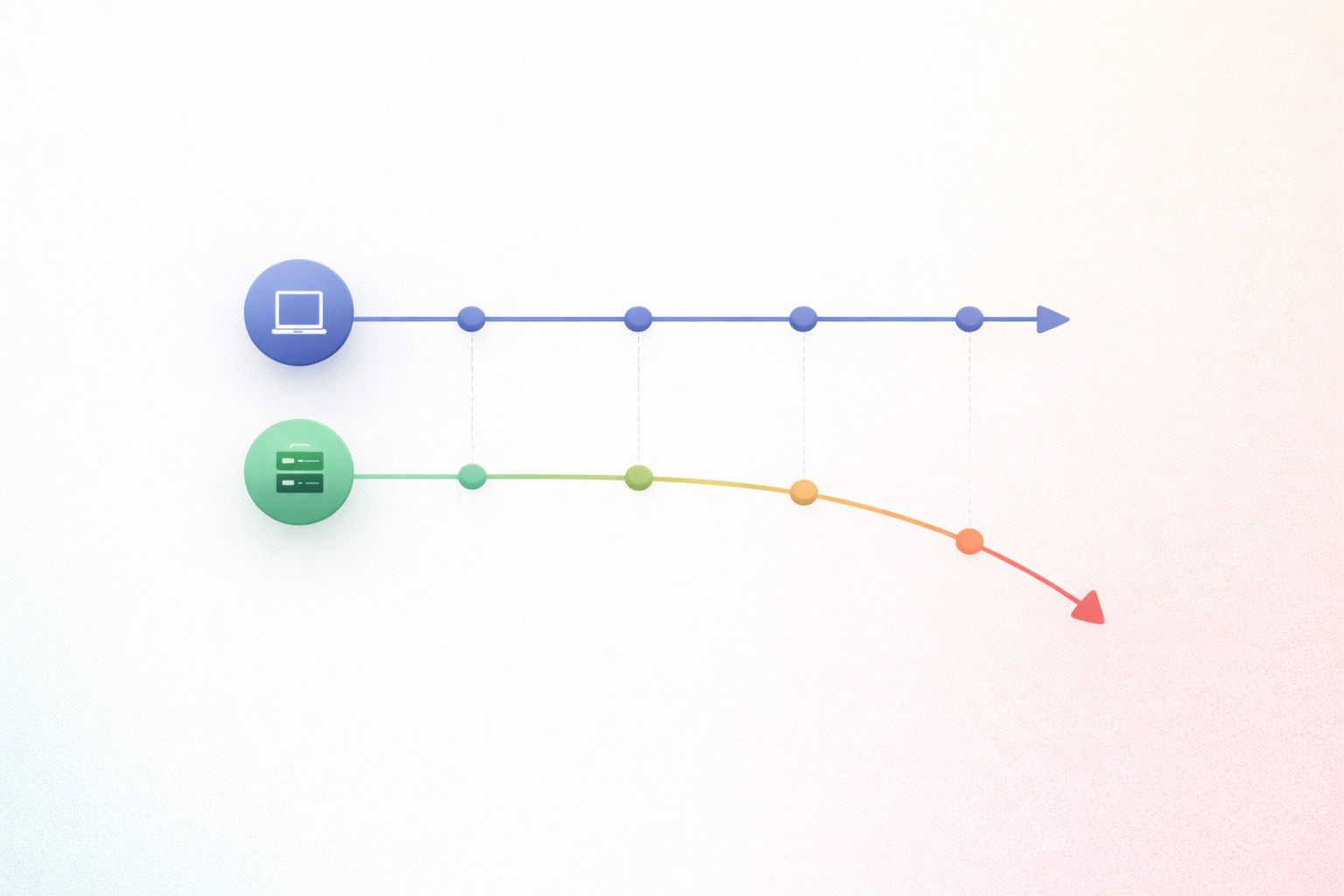
Let’s make this simple: environment drift happens when environments that are supposed to be identical slowly become different over time.
That’s it. No fancy definition needed.
You start with local, staging, and production environments that are aligned. Same configs, same dependencies, same infrastructure. Everything works as expected.
Then time passes.
A quick hotfix is applied directly in production. Someone updates a library version locally but forgets to sync it. A new environment variable is added in staging but never documented.
Individually, these changes seem harmless. But over time, they accumulate. And eventually, those environments are no longer the same.
Now your system behaves differently depending on where it runs.
That’s environment drift.
It’s not a sudden failure. It’s a gradual divergence—one that’s easy to ignore until it causes real problems.
And by the time you notice it, you’re no longer debugging code. You’re debugging inconsistency.
Why It Often Goes Unnoticed
What makes environment drift particularly dangerous is how subtle it is.
There’s no alert that says, “Your environments are drifting apart.” There’s no obvious failure at the moment it starts happening.
Instead, it creeps in quietly.
At first, everything still works. Tests pass. Deployments succeed. Nothing seems wrong.
Then small issues begin to appear:
-
A test fails in CI but passes locally
-
A feature behaves differently in staging
-
A bug only shows up in production
These issues don’t immediately point to environment drift. They look like isolated problems.
So teams treat them that way—fixing symptoms instead of addressing the root cause.
Another reason drift goes unnoticed is that it often lives outside the codebase. Configuration changes, infrastructure tweaks, and environment variables aren’t always version-controlled or visible to everyone.
That lack of visibility makes it easy for environments to diverge without anyone realizing it.
By the time drift becomes obvious, it’s already caused confusion, delays, and a lot of wasted effort.
How Environment Drift Happens
Manual Configuration Changes
One of the biggest sources of environment drift is simple: manual changes.
A developer logs into a server and tweaks a setting to fix an urgent issue. It works, the problem is solved, and everyone moves on.
But that change isn’t documented. It’s not applied to other environments. And it’s not tracked in version control.
Now production has a configuration that no other environment has.
Multiply this scenario over weeks or months, and you end up with environments that are fundamentally different—even if they started out identical.
Manual changes are tempting because they’re fast. But they’re also one of the fastest ways to introduce inconsistency.
Dependency and Version Mismatches
Dependencies are another common source of drift.
Let’s say your application depends on a specific version of a library. In one environment, it gets updated. In another, it doesn’t.
Suddenly, the same code behaves differently.
This can happen with:
-
Programming language versions
-
Package dependencies
-
System libraries
Even minor version differences can introduce subtle bugs.
And because these differences aren’t always obvious, they can go unnoticed for a long time.
Infrastructure Differences Over Time
Infrastructure isn’t static. Servers get updated, configurations change, resources are scaled.
If these changes aren’t managed consistently, environments begin to drift.
For example:
-
Production might run on newer hardware
-
Staging might use different scaling rules
-
Local environments might lack certain services entirely
These differences affect how applications behave—especially under load or in edge cases.
Over time, infrastructure drift can become just as significant as code changes.
The Hidden Impact of Environment Drift
“Works on My Machine” Revisited
Environment drift is one of the main reasons the phrase “works on my machine” still exists.
From the developer’s perspective, the code is correct. It works locally. Tests pass.
But in another environment, something breaks.
The issue isn’t the code—it’s the environment.
This disconnect creates confusion. Developers trust their local setup, but reality proves otherwise.
And because the environments are different, debugging becomes much harder.
Debugging Becomes Guesswork
When environments drift, debugging turns into guesswork.
You’re no longer asking, “What’s wrong with the code?”
You’re asking, “What’s different between these environments?”
That’s a much harder question to answer.
It requires comparing configurations, dependencies, infrastructure, and data—all at once.
And if those differences aren’t well-documented, you’re left piecing things together manually.
Why Modern Development Makes It Worse
Microservices and Distributed Systems
If environment drift was a problem in the monolith era, modern architectures have made it significantly worse.
With microservices and distributed systems, you’re no longer dealing with a single environment—you’re dealing with dozens, sometimes hundreds, of them. Each service can have its own configuration, dependencies, runtime, and scaling behavior.
That’s a lot of moving parts.
Now imagine drift happening not just across environments (local, staging, production), but also across services. One service might be running a newer version of a dependency. Another might have a slightly different timeout configuration. A third might rely on a feature flag that behaves differently depending on the environment.
Individually, these differences might seem small. But in a distributed system, small inconsistencies can amplify quickly.
A minor configuration mismatch in one service can cascade into failures across others. A dependency update in one component can break compatibility with another. Suddenly, you’re debugging interactions between systems—not just individual services.
And here’s the real challenge: no single person has full visibility into everything.
Each team owns their service. Each service evolves independently. Without strong coordination and standardization, drift becomes almost inevitable.
In this context, environment drift isn’t just a nuisance—it’s a systemic risk.
CI/CD Pipelines and Ephemeral Environments
CI/CD pipelines were supposed to bring consistency. And in many ways, they do. But they also introduce new forms of drift that are less obvious.
Pipelines rely heavily on ephemeral environments—temporary containers or virtual machines spun up for each run. These environments are designed to be clean and reproducible.
But reproducible doesn’t always mean identical.
Small differences can creep in:
-
Base images get updated
-
Dependencies are fetched dynamically
-
External services behave differently at runtime
Because these environments are short-lived, it’s hard to inspect or compare them after execution. If something goes wrong, you can’t just log in and investigate—you’re left with logs and artifacts.
There’s also the issue of pipeline configuration drift. Over time, CI/CD scripts evolve. Steps are added, removed, or modified. Different branches might use slightly different configurations.
Before you know it, the pipeline itself becomes another source of inconsistency.
So while CI/CD improves automation, it also requires discipline and visibility to prevent drift from creeping in unnoticed.
Real-World Examples of Environment Drift
A Feature That Breaks Only in Production
This is one of the most common—and frustrating—scenarios.
A feature works perfectly in local and staging environments. Tests pass. Everything looks good.
Then it’s deployed to production—and it breaks.
Why?
After hours of investigation, the root cause turns out to be something subtle:
-
A missing environment variable
-
A different database configuration
-
A slightly older version of a dependency
Nothing obvious. Nothing that would stand out immediately.
But enough to cause failure.
This is environment drift in action. The environments were assumed to be identical—but they weren’t.
And because of that assumption, debugging took far longer than it should have.
Inconsistent Test Results Across Teams
Another common example is inconsistent test behavior.
One developer runs tests locally—everything passes. Another runs the same tests—some fail. The CI pipeline shows a different result altogether.
Now the team is stuck asking:
-
Are the tests flaky?
-
Is there a bug in the code?
-
Or is something wrong with the environment?
Often, the answer is the last one.
Differences in dependency versions, runtime configurations, or even operating systems can lead to inconsistent results.
This erodes trust in the testing process. If tests aren’t reliable, developers start to question their value.
And once that trust is gone, quality suffers.
How to Detect Environment Drift Early
Monitoring Configuration Changes
You can’t fix what you can’t see—and that’s especially true for environment drift.
One of the most effective ways to detect drift early is to track configuration changes actively.
This means:
-
Version-controlling environment configurations
-
Logging changes to environment variables
-
Auditing infrastructure updates
When changes are visible, they’re easier to manage.
Instead of discovering drift after it causes issues, teams can catch it as it happens.
For example, if a configuration change is applied in production, it should trigger a review or alert. That way, the same change can be applied consistently across other environments.
Visibility turns drift from a hidden problem into a manageable one.
Using Drift Detection Tools
There are also tools specifically designed to detect environment drift.
These tools compare the current state of environments against a desired state—often defined in code. If differences are detected, they’re flagged immediately.
For example, in infrastructure as code setups, tools can:
-
Identify resources that were modified manually
-
Highlight configuration mismatches
-
Detect unauthorized changes
This is especially useful in cloud environments, where changes can happen quickly and at scale.
Drift detection tools act like a safety net. They don’t prevent drift entirely, but they make it much harder for it to go unnoticed.
Strategies to Prevent Environment Drift
Infrastructure as Code (IaC)
If environment drift is caused by unmanaged changes, the solution is simple in theory: manage everything as code.
Infrastructure as Code (IaC) allows teams to define environments in a declarative way. Instead of manually configuring servers or services, everything is specified in code and applied consistently.
This brings several advantages:
-
Environments can be recreated exactly
-
Changes are version-controlled and reviewable
-
Drift is minimized because manual changes are discouraged
Tools like Terraform, CloudFormation, and Pulumi have made IaC a standard practice in modern development.
But the real value isn’t just automation—it’s consistency.
When environments are defined in code, they become predictable. And predictability is the antidote to drift.
Immutable Environments
Another powerful strategy is using immutable environments.
In this model, environments aren’t modified after they’re created. Instead of updating a running system, you replace it entirely with a new version.
For example, instead of patching a server, you deploy a new one with the updated configuration.
This approach eliminates a major source of drift—incremental changes.
If every environment is created from the same definition and never altered manually, they remain consistent by design.
It also simplifies debugging. If something goes wrong, you know exactly what version of the environment you’re dealing with.
Immutable infrastructure isn’t always easy to implement, but it’s one of the most effective ways to maintain long-term consistency.
The Future of Stable Development Environments
Fully Reproducible Systems
The ultimate goal for many teams is fully reproducible environments.
Imagine being able to recreate any environment—local, staging, or production—with a single command. Same configurations, same dependencies, same behavior.
We’re getting closer to that reality with tools like containers, IaC, and environment templating.
But there’s still work to be done, especially around data and external dependencies.
As these tools evolve, reproducibility will become more accessible—and environment drift will become easier to control.
AI-Assisted Configuration Management
AI is also starting to play a role in managing environments.
Future systems may be able to:
-
Detect unusual configuration changes automatically
-
Suggest fixes for inconsistencies
-
Predict potential drift before it causes issues
Instead of reacting to problems, teams will be able to prevent them proactively.
This doesn’t eliminate the need for good practices, but it adds an extra layer of intelligence.
Conclusion
Environment drift is one of those problems that doesn’t announce itself loudly—but quietly undermines everything.
It creates inconsistencies, slows down debugging, and erodes trust in development workflows. And because it happens gradually, it’s easy to overlook until it becomes a serious issue.
Modern development practices—microservices, CI/CD, cloud infrastructure—have made systems more powerful, but also more prone to drift.
The solution isn’t to simplify systems, but to bring consistency back into them.
By adopting practices like Infrastructure as Code, immutable environments, and proactive monitoring, teams can reduce drift and regain control.
Because in the end, reliable software doesn’t just depend on good code—it depends on stable, predictable environments.

ASD Team
The team behind ASD - Accelerated Software Development. We're passionate developers and DevOps enthusiasts building tools that help teams ship faster. Specialized in secure tunneling, infrastructure automation, and modern development workflows.